If you're studying for your CDL and wondering exactly how many questions you're allowed to miss, the answer isn't a rule of thumb or a rumor from a trucking forum. It's written into federal regulation, and it applies the same way in every state.
The rule, word for word
Commercial driver licensing is governed by Title 49 of the Code of Federal Regulations. The passing standard for every CDL knowledge test comes from one specific section:
49 CFR 383.135(a)(1)
"...a driver applicant must correctly answer at least 80 percent of the questions" on each of the knowledge tests.
- Applies to the General Knowledge test
- Applies to every endorsement test (Hazmat, Tank Vehicles, Passenger, School Bus, Doubles/Triples)
- Applies to specialized tests like Air Brakes and Combination Vehicles
Why this matters more than it sounds like it should
A lot of first-time CDL applicants assume the General Knowledge test is the only one with a strict cutoff, and that endorsement tests are graded more loosely. They aren't. The 80% rule is written as a floor for "each of the knowledge tests," which means a Hazmat or Tank Vehicle endorsement exam holds you to exactly the same standard as the General Knowledge test. If you're stacking endorsements, you're clearing that 80% bar again for every single one.

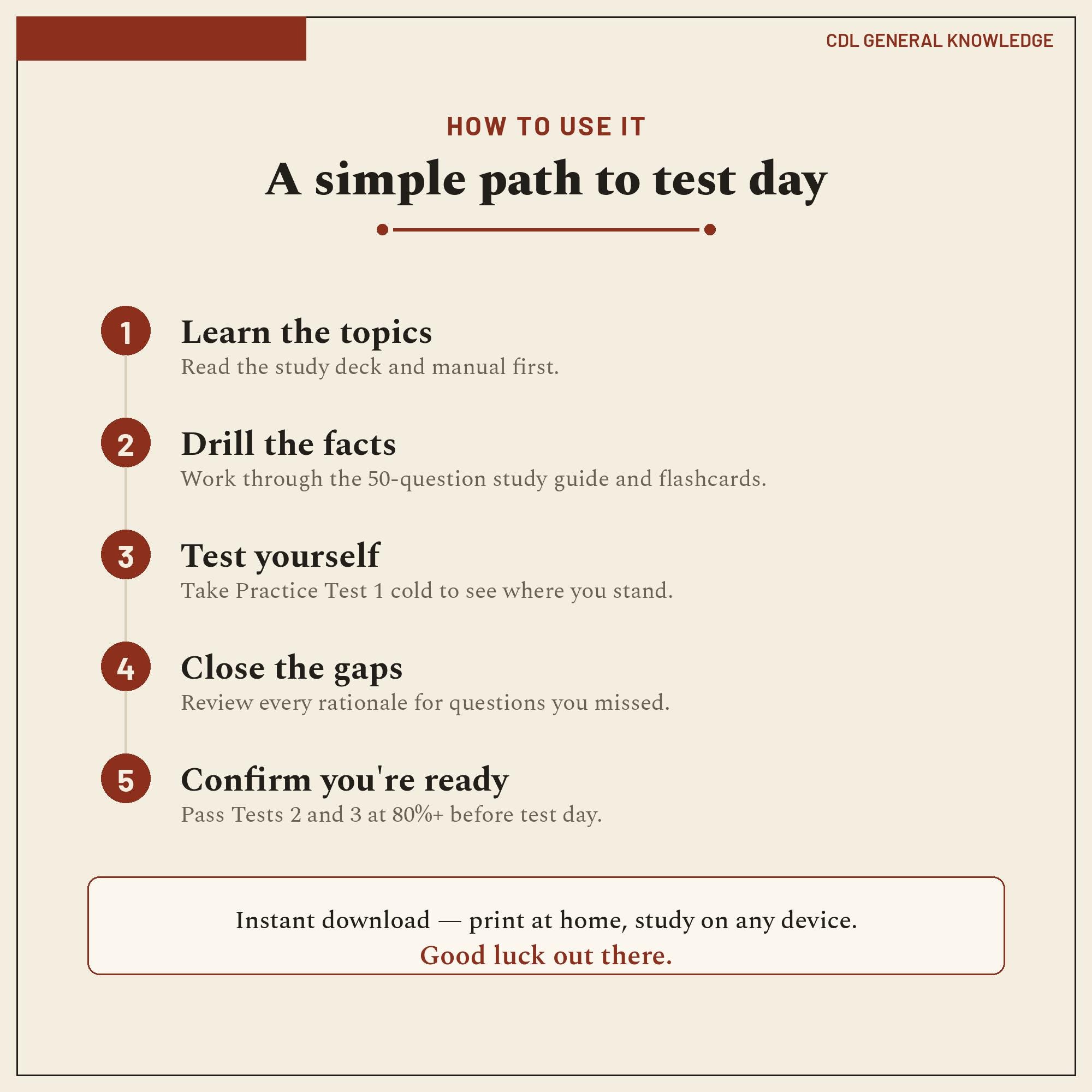
A full-length practice test with an answer key is the fastest way to see your real score before test day.
What 80% actually means on test day
On a standard 50-question General Knowledge exam, 80% works out to a specific, concrete number:
- 40 out of 50 correct to pass
- 10 or fewer wrong is the maximum margin for error
- The same math applies to each endorsement test you take, even though those exams often use a different total question count
That's a higher bar than a lot of applicants expect walking in. It rewards broad coverage of the material over cramming a handful of topics, since missing whole sections of the test (say, everything on air brakes or hours-of-service rules) can burn through your entire error margin by itself.
How to actually study to a 90%+ level
- Take full-length practice tests, not just flashcards. Flashcards build recall of individual facts; a full practice test tells you whether you can hit 80% under real exam conditions.
- Score yourself by category. A single overall percentage can hide a weak spot. If you're missing most of your points in one section, like combination vehicles or hazmat placarding, that's exactly where to spend your next study session.
- Retake practice tests until you're consistently above 90%. Since the real test only gives you a 20% margin, studying to a comfortable buffer above the 80% line means an off day still leaves you passing.
- Review the answer key, not just the score. Understanding why a wrong answer was wrong matters more than the number of points lost.
Who this is for
- First-time CDL applicants preparing for the General Knowledge test
- Drivers adding endorsements who need to know the same 80% rule applies to those exams too
- Anyone who wants a real practice-test score before walking into the DMV, not just a stack of memorized facts
Frequently asked questions
What percentage do I need to pass the CDL General Knowledge test?
At least 80%. Federal regulation 49 CFR 383.135(a)(1) requires a driver applicant to correctly answer at least 80 percent of the questions on each knowledge test. On a standard 50-question General Knowledge exam, that means at least 40 correct answers.
Does the 80% rule apply to endorsement tests too, like Hazmat or Air Brakes?
Yes. The regulation applies to "each of the knowledge tests," not just General Knowledge, so every endorsement exam and every specialized knowledge test carries the same 80% minimum.
Is the passing score set by my state or by the federal government?
It's federal. Individual states administer the test and issue the license, but 49 CFR 383.135 sets the nationwide minimum passing standard, so the 80% threshold doesn't vary from state to state.
How many questions can I get wrong on a 50-question test and still pass?
Up to 9 or 10, depending on rounding. Scoring 80% or higher on a 50-question exam means at least 40 correct. Some states use a different total question count, but the 80% rule stays the same.
What happens if I fail the test?
Retake policies, waiting periods, and fees vary by state, so check with your state's DMV or DPS for its specific rules. What doesn't vary is the 80% standard itself, since that comes from federal regulation.
150 original practice questions across 3 full tests, a 50-question study guide, flashcards, and a complete study manual, instant PDF download.