Seek and find, hidden object, I-spy: what is the difference?
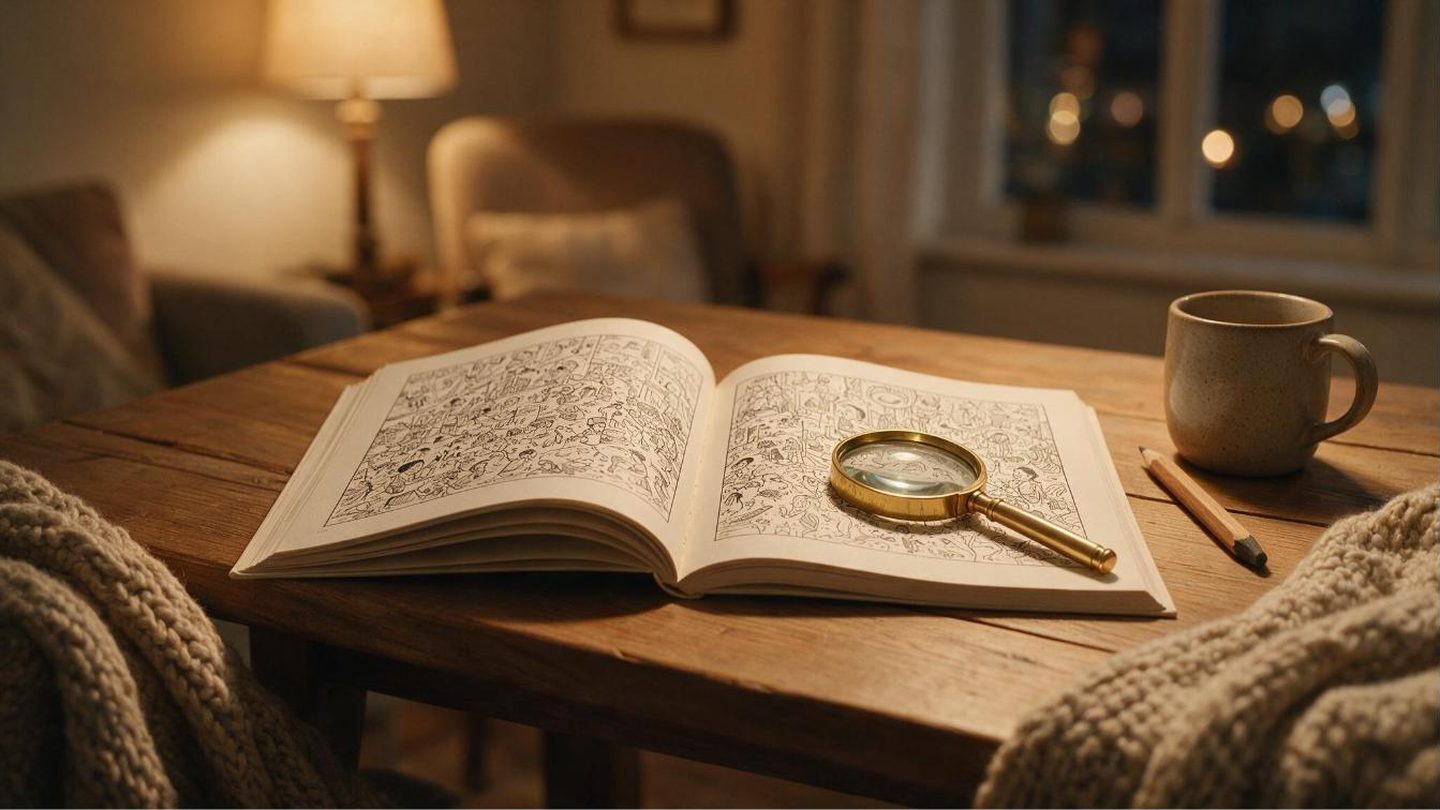
Seek and find. Hidden object. I-spy. Search and find. Look and find. The names get used interchangeably by shops and publishers, which is why you can buy two books described the same way and get two completely different experiences. The distinctions are real, and knowing them saves you buying a children's book for an adult.
The short version
| What you are given | What makes it hard | Usually aimed at | |
|---|---|---|---|
| I-spy | A busy scene, a rhyme or short prompt | Volume of clutter | Young children |
| Seek & find | A scene plus a printed list of items | How many items, how small | All ages, scales up well |
| Hidden object | A scene where items are disguised in the art | Camouflage, not size | Older children and adults |
| Where's-Wally style | A crowd scene, one recurring character | Repetition and decoys | All ages |
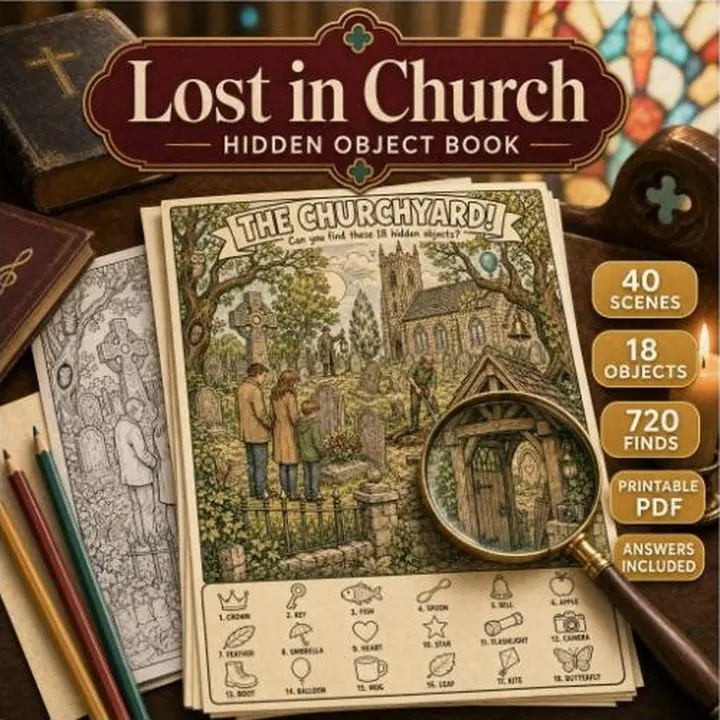
The useful line to draw is between small and disguised. A seek-and-find hides things by making them little and putting a lot of other things around them. A true hidden object book hides things by making them look like part of the picture — a key drawn as a branch, a fish shaped out of a cloud. The second is a different kind of difficult, and it is the one adults tend to want.
How to tell the difficulty before you buy
Product photos rarely say "hard". These four numbers do:
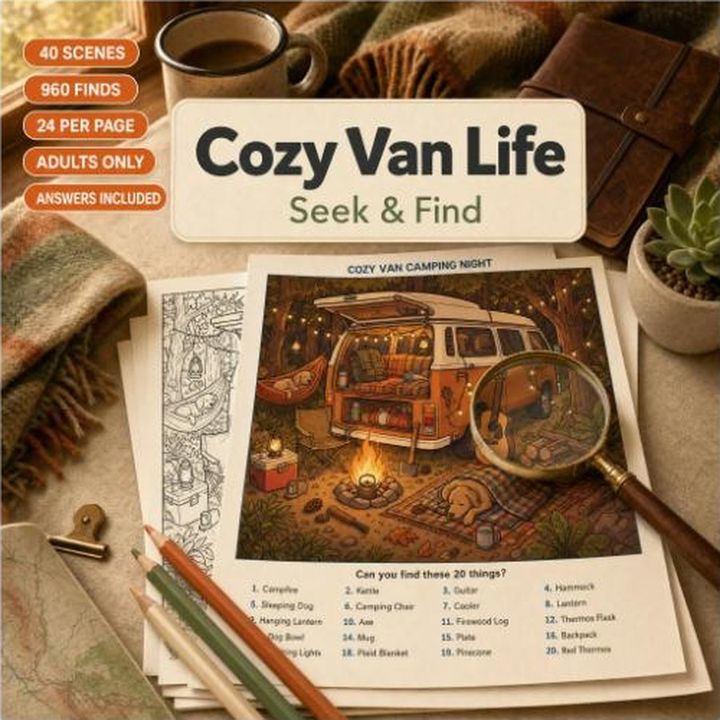
- Finds per page. Under ten is gentle. Around twenty is adult territory. Twenty-four or more on a single page means dense artwork and a long sit.
- Total finds. Multiply it out. Forty scenes at twenty-four finds is 960 individual searches — that is a book you own for months, not an afternoon.
- Line weight in the sample image. Fine, dense linework hides things. Thick cartoon outlines with white space do not.
- Whether answers are included. Not a difficulty signal but a quality one. A hard book without a solution key is a book that will eventually annoy you.
Why adults keep coming back to these
A seek-and-find asks for a specific kind of attention: narrow, visual, and completely incompatible with worrying about anything else. You cannot scan a cluttered illustration for a thimble and also compose an email in your head. That is the appeal, and it is the same reason people who bounce off meditation apps get on fine with a puzzle book.
It also has a clean stopping point. Unlike a phone, the page ends.
Printable versus a physical book
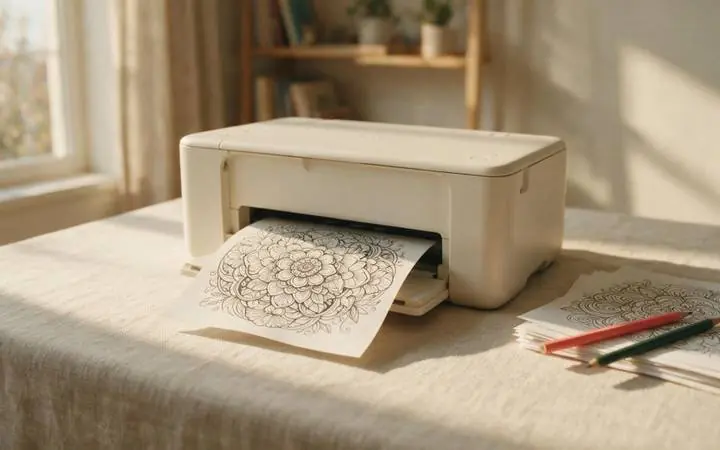
Most of these are sold as printable PDFs now, which changes two things worth knowing.
You can print a page more than once. Obvious, but it matters more than it sounds — a family can each have their own copy of the same scene and race, and a classroom or care home can run the same activity thirty times from one purchase.
Print quality is on you. These books live or die on fine detail, so this is one of the few printable formats where paper and settings genuinely change the experience. Print at 100 per cent scale, not "fit to page", and use at least 100 gsm so the linework does not grey out. Our home printing guide covers the settings, and the paper guide covers weights.
Where logic puzzles fit
Different muscle entirely. A seek-and-find is visual search — you are scanning. A logic puzzle is deduction — you are reasoning from constraints, and there is nothing to look for. People who find search puzzles frustrating often love logic grids, and the reverse is just as common.
If you are buying for someone else and cannot tell which they are, a book with both is the safer gift. Our puzzle collection has seek-and-find, hidden object, word and number search, and giant logic grids in the same place.
A note on kids' versions
"For kids" on a seek-and-find usually means three things: fewer finds per page, larger objects, and no camouflage. What it does not usually mean is a simpler scene — children are often better at raw visual scanning than adults, and a busy page is part of the fun. If you are buying for a child who reads well, the adult books are frequently fine; it is the mature-humour titles you want to check, not the difficulty.
And if you want to test the format before spending anything, there are printable pages in our free folder to run through the printer first.
Forty scenes, answers included
Seek-and-find, hidden object, word search and giant logic grids — every book ships with a full solution key.
Browse the puzzle books →